

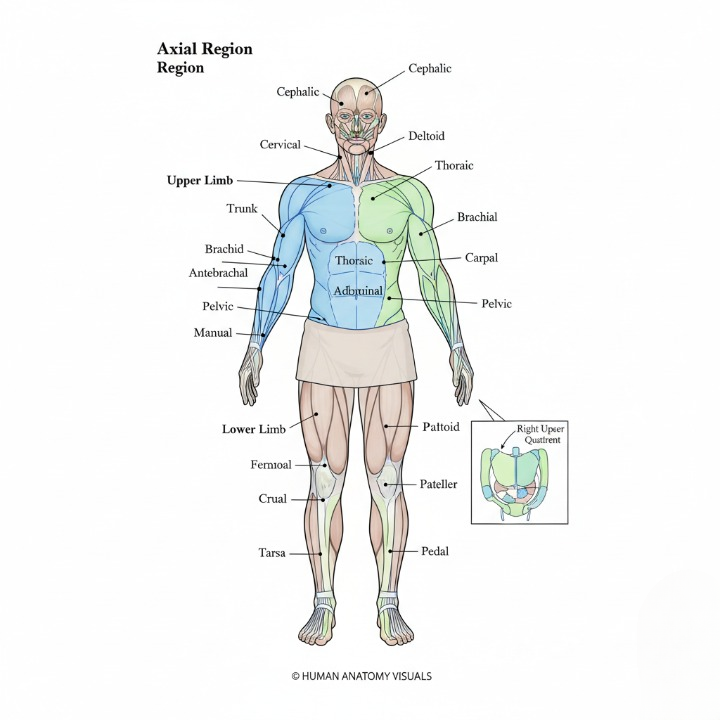
Understanding body regions is a fundamental part of human anatomy. These regions help students, healthcare professionals, and researchers describe locations, identify structures, and communicate accurately. This guide explains body regions clearly and systematically, making anatomy easier to learn and remember.
What Are Body Regions?
Body regions are specific areas into which the human body is divided for anatomical reference and study. Instead of describing the body as a whole, anatomists use regions to pinpoint exact locations of organs, muscles, bones, and injuries.
This regional division improves clarity, precision, and consistency in anatomy and medicine.
Why Are Body Regions Important?
Body regions are important because they:
-
Provide a standard anatomical language
-
Help locate organs and structures accurately
-
Support medical diagnosis and education
-
Improve understanding of human body organization
-
Reduce confusion in clinical communication
Without body regions, describing the human body would be unclear and inconsistent.
Major Divisions of Body Regions
The human body is broadly divided into two main regions:
1. Axial Region
The axial region forms the central axis of the body and includes areas essential for protection and support.
It consists of:
-
Head (Cephalic region)
-
Neck (Cervical region)
-
Trunk
2. Appendicular Region
The appendicular region includes the limbs, which are attached to the axial region.
It consists of:
-
Upper limbs
-
Lower limbs
Detailed Explanation of Body Regions
1. Cephalic (Head) Region
The head region contains vital organs such as the brain, eyes, ears, nose, and mouth.
Subregions include:
-
Frontal (forehead)
-
Orbital (eye)
-
Nasal (nose)
-
Oral (mouth)
-
Occipital (back of head)
2. Cervical (Neck) Region
The cervical region connects the head to the trunk and supports movement and vital pathways like blood vessels and nerves.
3. Trunk Region
The trunk is the central part of the body and includes:
Thoracic Region
-
Chest area
-
Contains heart and lungs
Abdominal Region
-
Houses digestive organs
-
Often divided into four quadrants or nine regions
Pelvic Region
-
Contains urinary and reproductive organs
4. Upper Limb Regions
These regions allow movement, grasping, and manipulation.
Includes:
-
Shoulder (Deltoid)
-
Arm (Brachial)
-
Forearm (Antebrachial)
-
Wrist (Carpal)
-
Hand (Manual)
5. Lower Limb Regions
Lower limbs support body weight and movement.
Includes:
-
Thigh (Femoral)
-
Knee (Patellar)
-
Leg (Crural)
-
Ankle (Tarsal)
-
Foot (Pedal)
Clinical Importance of Body Regions
In medical practice, body regions help:
-
Identify injury locations
-
Describe surgical sites
-
Record patient symptoms accurately
-
Avoid misunderstandings in treatment
For example, saying “pain in the right lower abdominal region” is far more precise than simply saying “stomach pain.”
Common Mistakes Students Make
-
Confusing regional terms with everyday language
-
Mixing axial and appendicular regions
-
Ignoring sub-regional classifications
-
Memorizing without understanding location
Tip: Always visualize the region on the body while learning.
How to Learn Body Regions Easily
-
Study with diagrams
-
Practice labeling body charts
-
Use anatomical terminology regularly
-
Relate regions to real-life movement
-
Revise with short notes and quizzes
Conclusion
Body regions are the foundation of human anatomy.
By understanding how the body is divided and named, learners gain clarity, accuracy, and confidence in anatomical study. This complete guide provides a structured and professional explanation to help students and professionals master body regions effectively.
